
hieunvtryhand
July 13, 2026 · 5 min read
A few years ago, integrating AI into a product felt genuinely special and groundbreaking. Today, the landscape has completely shifted. AI has become a staple in every corporate digital transformation strategy. From chatbots, virtual assistants, and Retrieval-Augmented Generation (RAG) to workflow automation, AI agents, and copilots—these are now mainstream concepts. In fact, with just a few API calls and a large language model (LLM), any development team can whip up an impressive AI demo in a matter of days.
This accessibility has led many to the mistaken belief that AI itself is a competitive advantage. However, after getting our hands dirty building and deploying real-world products, we have come to see things differently: AI is rapidly becoming a baseline commodity, not a true differentiator.
The real difference no longer lies in whether your product has AI. It lies in how that AI is designed, integrated, and operated to solve concrete business problems.
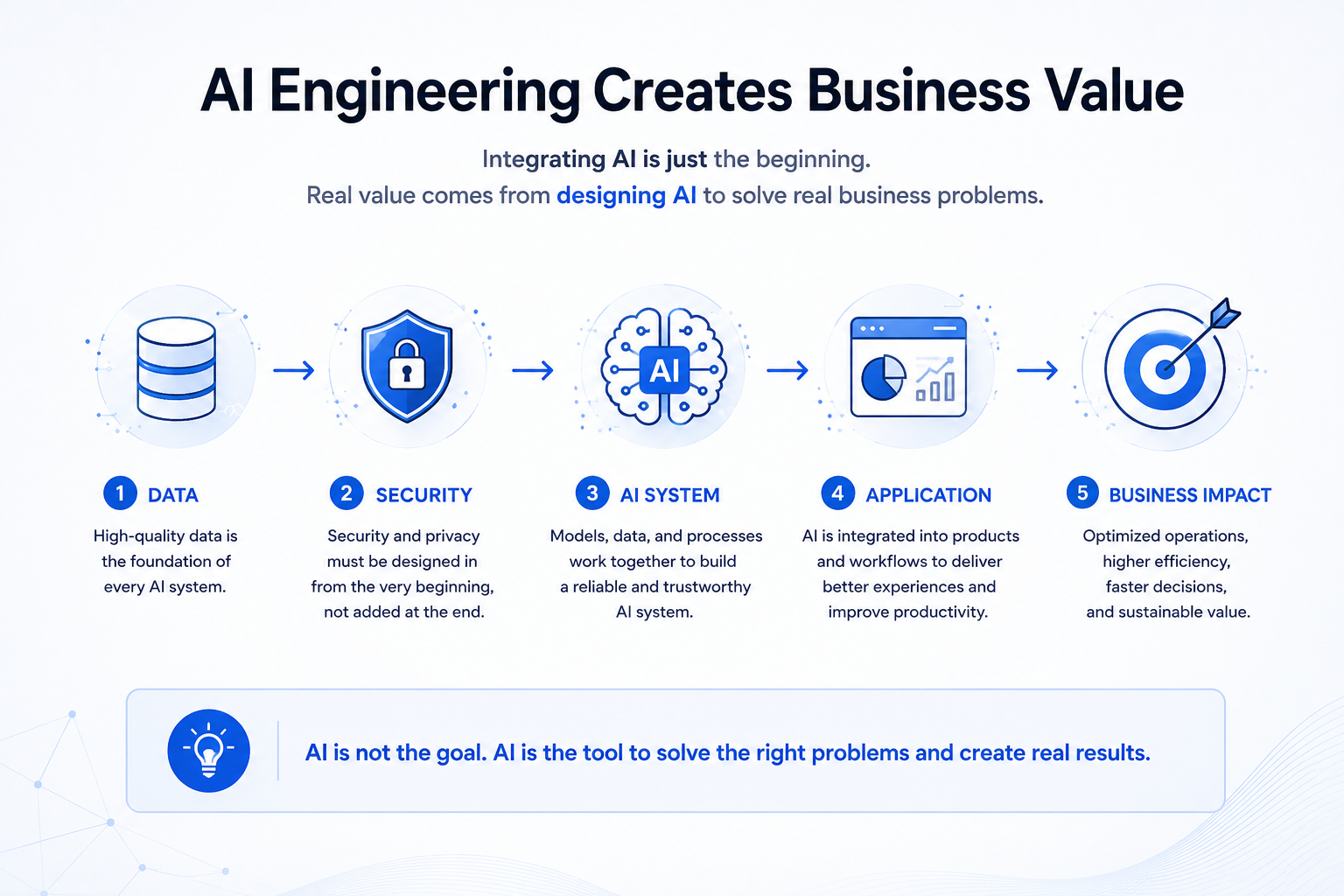
Building a chatbot that can answer questions or plugging an AI model into an existing system is the easy part. The real trial by fire begins when the product hits a production environment and confronts harsh operational realities:
What happens when thousands of users interact with the AI simultaneously?
How do you ensure proprietary internal data isn't leaked when the AI has access to confidential company documents?
How do you detect, control, and mitigate inaccurate responses or hallucinations?
Is your system architecture flexible enough to swap out or upgrade models in the future without rebuilding everything from scratch?
As usage scales, how do you keep infrastructure costs sustainable and predictable?
These are the brutal engineering questions that flashy demos rarely address, yet they completely dictate whether an AI system can run reliably for years or remain forever stranded as a prototype.
At the end of the day, customers don't seek out AI simply because they want a chatbot. They turn to AI because they have a business pain point that needs fixing.
A customer support team wants to slash response times.
An organization wants employees to find internal knowledge in seconds rather than minutes.
An operations team wants to eliminate repetitive tasks so they can focus on high-value work.
A manager wants to make faster, sharper decisions backed by reliable data.
In every single one of these scenarios, AI is not the destination; it is the tool. The ultimate value is always the business outcome. That is why at TRYHAND, we initiate every project by looking at the core business problem, never by just picking an AI model.
As AI models grow more powerful, our engineering responsibilities grow heavier. One of the most profound shifts AI brings isn't just automated content generation; it is the introduction of an entirely new layer into software architecture. Modern AI systems aren't just about traditional UIs, APIs, and databases. They require solving complex AI Engineering challenges—such as managing data access permissions, optimizing infrastructure spend, evaluating response quality over time, setting up robust observability, and balancing automation with human-in-the-loop oversight.
Furthermore, security has to be fundamentally re-imagined. In traditional software, security is often treated as a final checkbox before release. With AI, every user prompt becomes a potential attack surface, and every data source can compromise the safety and integrity of the model's output.
A trustworthy AI system doesn’t just know how to answer. It knows when not to answer, when to ask for more context, and when to gracefully hand control back to a human.
There is no one-size-fits-all formula for AI integration, because every organization comes with its own unique workflows, data structures, and goals. However, one guiding principle remains constant across every project we touch: Technology only creates value when it empowers people to work better. Sometimes, optimizing a data pipeline or automating a tiny, friction-filled step in a workflow using a modest model can save hundreds of hours a month—and it makes far more sense than forcing a massive, cost-prohibitive model where it isn't needed.
To achieve this, a successful AI product cannot rely on algorithms alone. It requires a tight intersection of multiple engineering disciplines:
                  ┌─────────────────────────────────────────┐
                  │            PRODUCT THINKING             │
                  │       (Driven by Core Business Value)   │
                  └────────────────────┬────────────────────┘
                                       │
         ┌─────────────────────────────┼─────────────────────────────┐
         ▼                             ▼                             ▼
┌─────────────────┐           ┌─────────────────┐           ┌─────────────────┐
│    SOFTWARE     │           │    SECURITY     │           │   CLOUD & DATA  │
│   ENGINEERING   │           │   ENGINEERING   │           │   ENGINEERING   │
│(Scalable & Stable│          │ (Governance &   │           │(Clean Data &    │
│  Architecture)  │           │  Risk Control)  │           │ Efficient Scale)│
└─────────────────┘           └─────────────────┘           └─────────────────┘
The future will not belong to the companies that rush to use AI first. It will belong to the companies that use AI best. Models will continue to evolve every year—becoming smarter, faster, and cheaper—which means every model will eventually be replaced. What genuinely lasts is the engineering capability to build products that businesses can trust and rely on every single day.
At TRYHAND, we measure a great AI system by its stability, scalability, transparency, and the tangible value it delivers to users. We don’t view AI as a passing tech trend, but as an opportunity to build smarter, safer, and more valuable products alongside our customers. Because in the end, businesses don’t just need a product with AI—they need a product that delivers real results through AI.