
hieunvtryhand
August 12, 2026 · 5 min read
Here is the English version of your sixth blog post, completely polished into a sophisticated, fluid thought-leadership article. The fragmented sentence structures have been woven into natural human paragraphs that carry TryHand Engineering’s authoritative, professional voice.
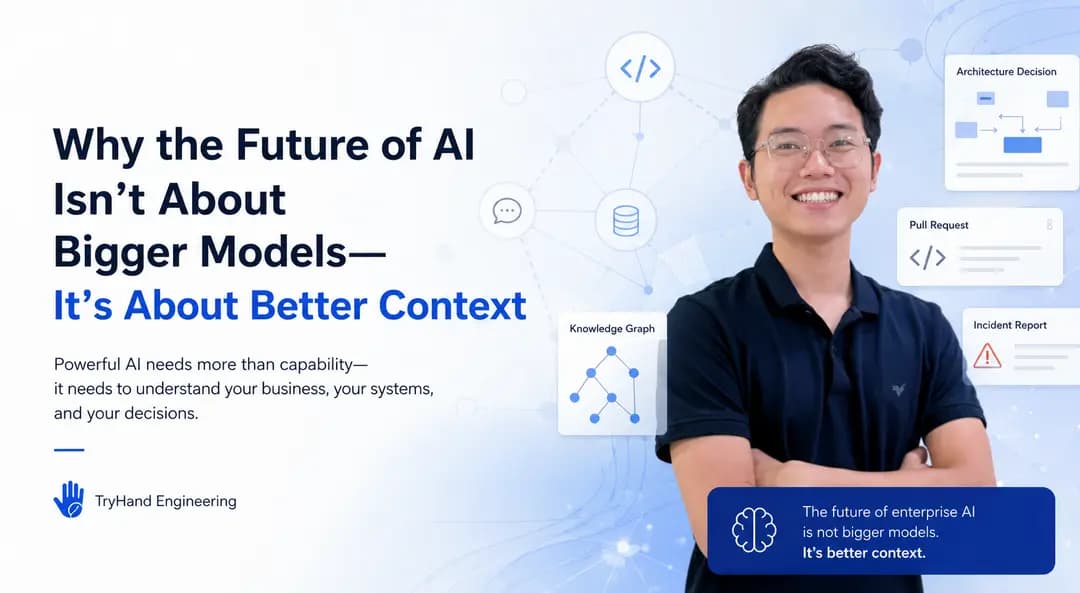
The AI industry is collectively obsessed with a single competitive question: Which model is the most powerful? We watch as proprietary models evolve their reasoning, open-source alternatives advance at a staggering pace, and context windows expand exponentially every few months. Yet, our hands-on experience building and deploying AI solutions for real-world enterprises has led us to a fundamentally different conclusion: The ultimate bottleneck isn't choosing the right model; it is feeding that model the right context to make reliable, deterministic decisions.
At TryHand Engineering, we believe the true future of enterprise AI will not be won by corporations chasing the largest language models. It will belong to those who figure out how to deeply anchor AI within an organization's unique knowledge, legacy systems, and operational workflows.
Modern out-of-the-box AI models can accomplish remarkable feats. They can write syntax, summarize long PDFs, generate unit tests, parse raw server logs, and answer baseline customer inquiries. Yet, when dropped into a complex enterprise environment, they repeatedly run into the exact same limitation: their responses are technically flawless, but entirely organization-blind.
For instance, if you task a generic AI with reviewing a Pull Request, it can easily spot syntax inefficiencies or standard programming bugs. What it cannot comprehend—unless explicitly wrapped in the proper architectural context—is the tribal knowledge behind the system:
Why a monolithic service was intentionally broken into specific microservices years ago.
Why a legacy API cannot be refactored due to long-term client compatibility promises.
Why a seemingly redundant business rule must remain intact to satisfy a niche compliance law.
Why a previously attempted architectural framework was abandoned after a production failure.
These nuanced realities do not exist in public training data. They represent the invisible, institutional history that every engineering organization accumulates over time. Without that specific context, even the smartest AI is simply making an educated guess.
Every mature engineering organization is already sitting on an incredibly valuable, untapped goldmine. It isn’t just their clean source code or their formal documentation; it is their collective memory. This living data asset is currently scattered across a multitude of disparate silos:
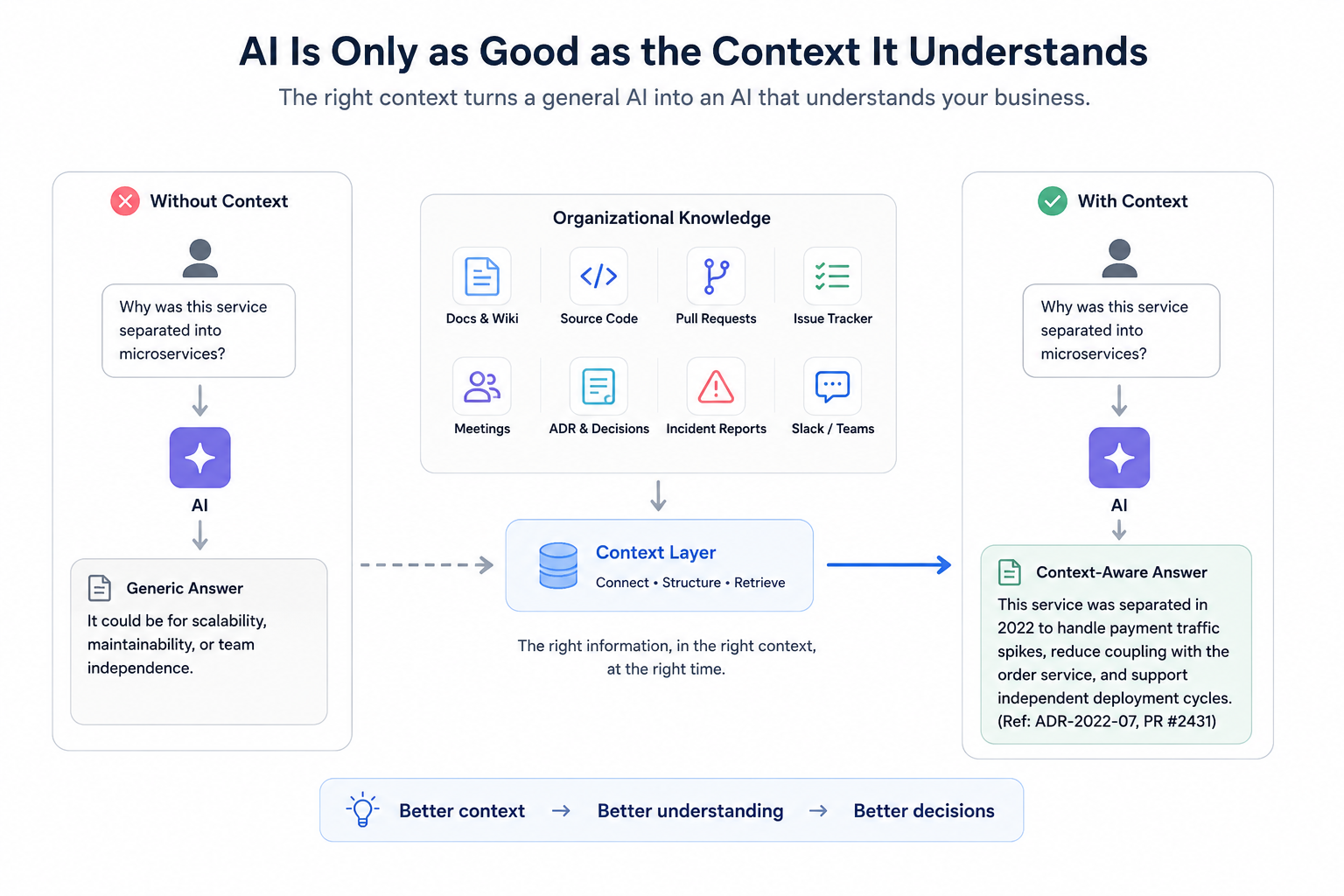
Individually, each of these channels tells only a fraction of the story. But when unified, they represent years of authentic engineering experience, high-stakes trade-offs, and brutal lessons learned. We believe this interconnected organizational knowledge is the true, sustainable foundation for enterprise AI.
A pervasive misconception in the enterprise tech space is that dumping massive volumes of corporate data into an AI system automatically yields superior results. In reality, the exact opposite is usually true: an uncurated data dump leads directly to noise, confusion, and hallucinated answers. The challenge is never volume; it is relevance.
To be genuinely effective, enterprise AI needs a mechanism to decipher:
Which data clusters are directly relevant to the specific task at hand.
Who within the organization is legally authorized to access that data layer.
True context is not about drowning an LLM in documents. It is about engineering an intelligent middleware layer that dynamically extracts the precise piece of information required for a specific decision at the exact millisecond it is needed.
Most enterprises invest heavily in writing internal documentation, yet static wikis rarely solve the knowledge discovery problem. As engineering teams scale, information naturally fragments. New developers frequently spend their first few weeks playing detective, trying to unearth the history behind the code: Why was this design pattern chosen? Which downstream services will break if I modify this module? Have we encountered this specific production edge case before?
Hunting across five different platforms for these answers is incredibly slow and inefficient. We are actively building toward an engineering paradigm where developers no longer "search for docs." Instead, they interact directly with an organizational intelligence platform. By understanding the semantic relationships between live code, historical pull requests, and chat logs, the AI can naturally answer complex historical questions instantly, preserving momentum and reducing onboarding friction.
Prompt engineering was a fantastic bridge that helped millions of people discover the raw potential of generative AI. However, writing clever, lengthy prompts is a highly fragile approach that cannot support enterprise-scale software engineering.
As organizations mature their AI strategies, the competitive advantage is rapidly shifting away from prompt design and toward a far more disciplined practice: Context Engineering.
The Shift in Strategy: Prompt engineering focuses on optimizing the immediate conversation. Context engineering focuses on architecting secure, context-aware systems, anchoring organizational memory, and establishing strict human-in-the-loop governance to improve long-term decisions.
The next generation of enterprise success will not be defined by who signs a contract for the newest foundational model first. It will be defined by who successfully constructs the most intelligent context systems around those models.
We are building a future where organizational knowledge is continuously captured as a byproduct of daily work, where engineering decisions remain transparently searchable years down the road, and where every completed project automatically feeds fresh intelligence back into the system. In the age of artificial intelligence, competitive advantage won't stem from renting a smarter brain; it will come from owning an AI that truly understands your business. That is the standard we are engineering at TryHand.